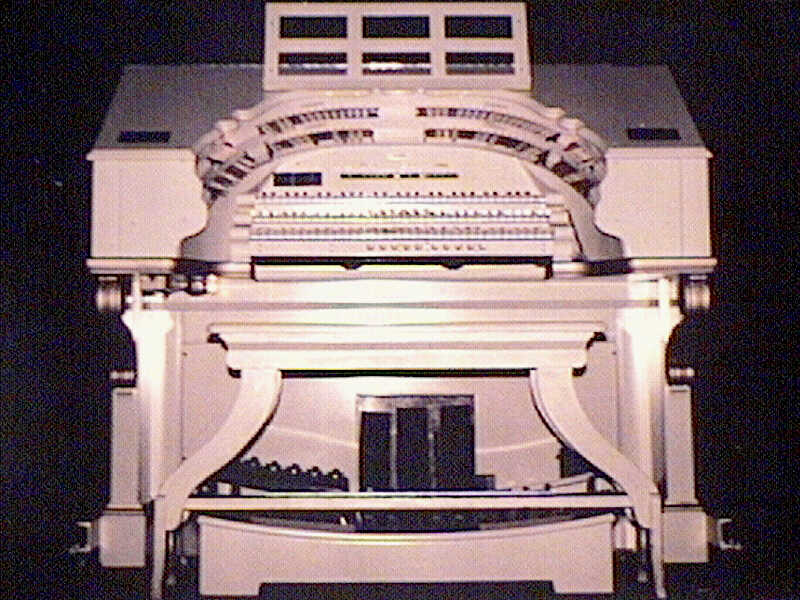
L.A. Orpheum Wurlitzer Console
L.A. Orpheum Wurlitzer
Console
This Page: The
Theatre * The Organ *
Organists &
Presentations * Stoplist *
Maintenance
* Getting
There * Related Info
Page Last Updated: July 6, 2014
The Los Angeles Orpheum Theatre is the last of four Orpheum Theatres built in L.A. Situated at 842 South Broadway, downtown Los Angeles, it is near the southern end of Los Angeles' Historic Core theatre district. Built in 1926 for Vaudeville but closed briefly during the Great Depression, the Los Angeles Orpheum Theatre is owned and operated by Steve Needleman of ANJAC Fashion Buildings as a special events venue. Contact Orpheum General Mangager Christian Andrade via the L.A Orpheum Website for information on theatre availability.
The theatre is open for bookings after an architecturally sensitive 3 million dollar renovation. Items upgraded include new air conditioning, audio systems and fly system, electrical facilities, parking improvements and restroom expansion. Careful attention was paid in returning the theatre to its original color scheme, retention of the original floor plan, and restoration of the beautiful marble in the lobby. Even the roof sign restoration included retention of its original incandescent lamp lettering.. This work crowns and completes restoration efforts underway for years by many devoted to preservation of this theatre.
This beautiful theatre was featured in a Theatre Historical Society Of America convention in late June 1998 and again in 2005.
The organ is an original installation Wurlitzer, Style 240 Special, Opus 1821, shipped 12/23/27. Originally 13 ranks, an added Post Horn makes the total for this 3 manual organ 14 ranks. This is one of only 3 remaining original theatre organ installations in theatres in Southern California.
Organist Newell Alton wrote his dedication program for this instrument on the inside of the Solo chamber wall, dating it 4/8/28. Some of his concert selections include "Orchestral Novelty, Chloe - Electrola etc, Civic Pride Novelty, 2nd Hungarian Rhapsody". Organist James S. Roseveare also penned his signature on the Solo chamber wall, dated 5/18/76.
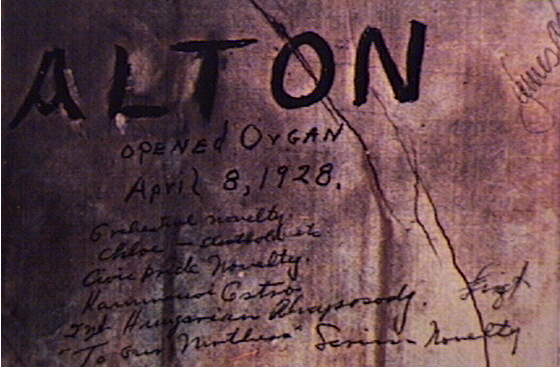
Newell Alton's opening
program
written on Solo Chamber wall 1928
Many consider this organ to have a beautifully cohesive ensemble sound.
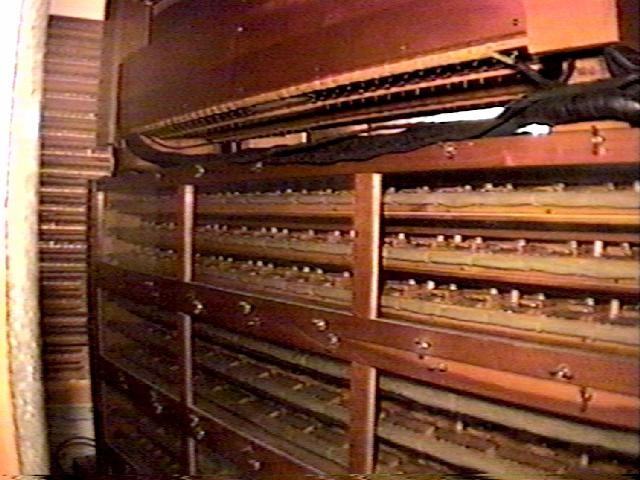
The original Wurlitzer electropneumatic relay and console continue to do their good service in this original installation organ. Of over 2000 organs built by Wurlitzer, there are perhaps fewer than 50 in company with the Los Angeles Orpheum Wurlitzer in having the dual distinctions of both remaining in their original installation homes and operating on their original electro-pneumatic relays and combination actions. The relay contains a multi-pole single-throw fast-operating key relay for every key and pedal in the console, plus a 61-(or 49- or 37-) pole single-throw switchbar relay for every tonal stop in the console. Every key relay, stop relay and windchest pipe pallet action uses an electromagnet and two-stage valve-and-pneumatic arrangement to provide fast-moving, low mass electrical contacts in the key relay or fast acting light-weight mechanical control of wind supply to each and every individual pipe and percussion in the organ. Additional relays and windchests inside the console permit the organist to change preset combinations of stops while playing by pressing pre-set thumb pistons. The motive power for all these fast-moving parts comes from the wind supply sourced by a 7-1/2-Horsepower blower in the basement of the theatre. Low voltage low power (1-Watt per electromagnet) electrical contact circuits are used for control but not in any significant way for mechanical power.
Staff organists over the years have included Newell Alton, Henry Murtaugh, Eddie Eben, Price Dunlavy, William Denton and Robert York.
Formal Programs utilizing or showcasing the Orpheum Wurlitzer include:
Tonal Resources:
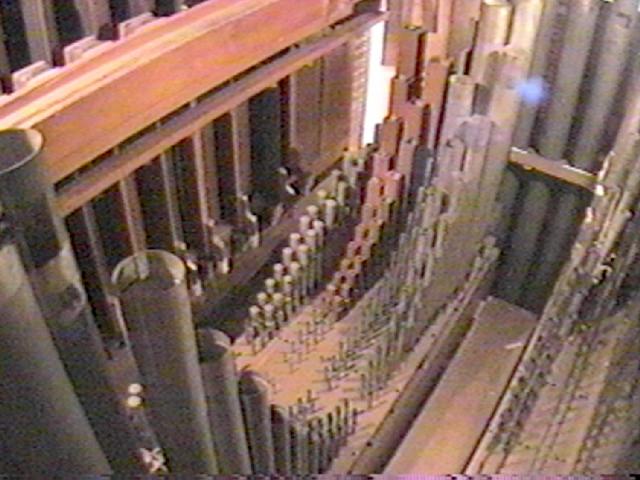
MAIN Chamber (Left Side)    Pedal     Accomp.          Great         Solo

16 Diaphonic Diapason      16 8 4       8             16 8 4           8

 8 Horn Diapason                        8                8

 8 Clarinet                   8         8 8s             8             8

 8 Viol d'Orchestra           8+C       8 4              8 4 2

 8 Viol Celeste                         8 4              8 4

 8 Salicional                           8 4              8 4

16 Concert Flute           16 8      16 8 4 3 2       16 8 4

 8 Vox Humana                           8 4              8

   Chrysoglott(49n)                     X                X

   All Main chamber pipework on 10" wind except Vox, on 6"
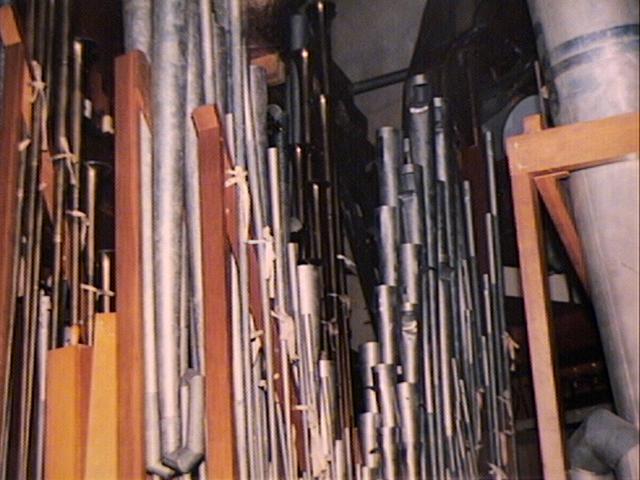 Solo ranks from the side.
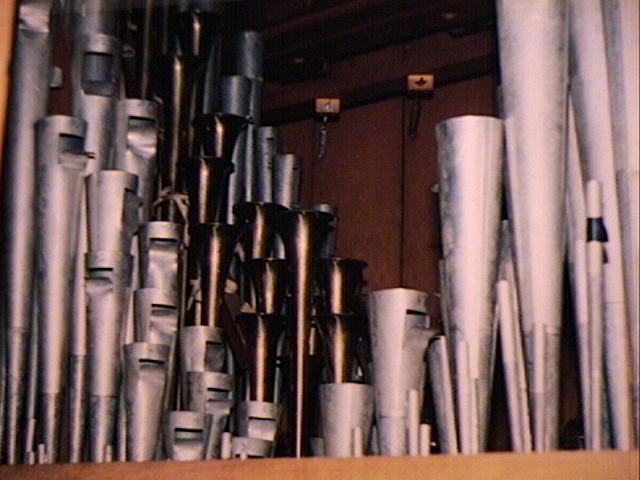 Solo
reed resonators
Solo
reed resonators
SOLO Chamber (Right Side)

 8 Eng Post Horn(not orig)              8                8              8

 8 Brass Trumpet                        8                8              8

16 Harmonic Tuba           16 8         8 8s      16 16s 8 4         16 8 4

 8 Tibia Clausa               8         8 8s 4  16tc 16s 8 4 3 2 1      8 4

 8 Orchestral Oboe                      8                8              8

 8 Kinura                               8                8              8

   Acc to ...                           4

   Great to ...               8                        16  4

   Solo to ...                          8s

   Marimba(re-it)/Harp(49n)             M H              M H

   Xylophone(37n)                       Xs               X              X

   Orch Bells(re-it)/Glock(30n)                         G B            G B

   Cathedral Chimes(25n)                Xs               X              X

   Tuned Sleigh Bells(25n)              Xs               X

   Bass Drum                  X

   Kettle Drum                X

   Snare Drum                           X

   Triangle                             Xs

   Tambourine                           X

   Castanets                            X

   Chinese Block                        X

   Crash Cymbal/Cybmals       X

'3'=2-2/3  '1'=1-3/5  's'=second touch  '+C'=Unison and Cleste ranks play

together on this one stop  'tc'=Tenor C stop
All Solo chamber pipework (including added Post Horn) on 10" wind except Tuba and Tibia, on 15". All toys and traps on 10" wind.
Trems: Main, Solo, Vox, Diaphone Tuba (really just the Tuba), Tibia
3 Pedal Pistons on first 3 of 7 Toe Studs 10 Acc Pistons 10 Great Pistons 6 Solo Pistons
Main, Solo/Master and Crescendo Swell Shoes
The organ would not be playing today were it not for restoration and conservative rebuilding work of Eugene F. Davis and volunteer crew, completed in 1982. Work included a complete releathering of the chests, relay and console. Tonally conservative modifications included additions to Tibia unification and some changes in the couplers.
The organ is maintained under invitation of Steve Needleman by a volunteer crew including Arthur Omura, Steve Asimow, James Henry, Steve Asimow, and others. The crew chief is John Koerber.
Regulation, tuning and professional direction is handled by Thomas L. DeLay, who has done this work since Dan Bellomy's American Theatre Organ Society (ATOS) National Concert in 1996
Prior volunteer Crew Chiefs include Cliff Schwander, Bob Busch, Eugene Davis, Chuck Malone.
Locality:
Get to Los Angeles, California, USA. From the 110 (Harbor) Freeway, take the 9th Street exit (north of the 10, south of the 101 freeways). Go east, several blocks. At Broadway, turn left and proceed halfway up the block. Entrances to parking lots are on both the left and right sides of Broadway just past the Orpheum marquee. Parking is usually $10 on weekdays, $5 on weekends. There is additional parking available from Spring Street between 8th and 9th street behind the theatre.
Related Info:
Photos by Cliff Schwander, Pat Mower, John Koerber
Thanks to Jerrell Kautz of the Theatre Organ Home Page for hosting services