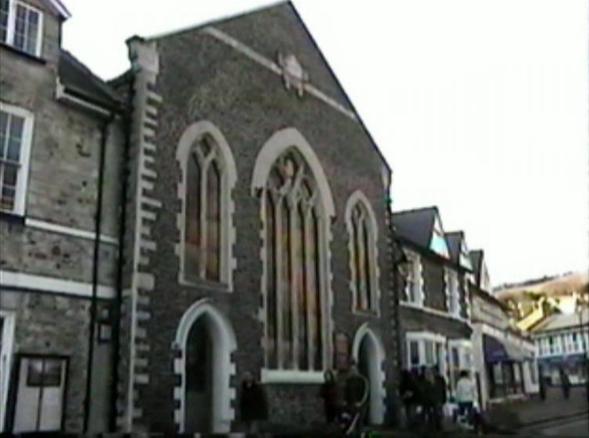
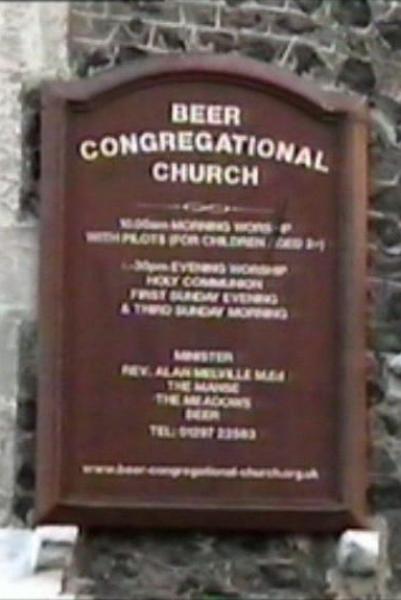
Congregational Church - Fore Street - Beer - East Devon - UK
Unfortunately it became necessary for me to formally dissolve Friends of BeerWurly with effect from 22nd September 2009 after the good (and supposedly christian) rulers of Beer Congregational Church appeared to have developed a problem with my sexual orientaton and general lifestyle although this, and also my agnostic beliefs, were well known from the start!
Were it not for my sole efforts this relic of the past would still be in the same condition in which it was when I first took an interest in it in 2008.
Following my departure a new organisation was formed by the church and a few well-wishers, although to date progress has been slow.
There are now some signs of hope, although only time will tell!
When I originally shut this site down in 2009 it was my honest belief that there would not be much further progress down there HOWEVER:
I am now glad that, largely due to the dedication of my successor Glen Twamley and his newly discovered "helper" Geoffrey Archer, the organ is now virtually restored to its former glory, so I am pleased to set the record straight.
If you want to know more about recent developments please see their NEW WEBSITE.
Sadly though, like most of the other installations around the UK no-one else, apart from the immediate supporters, seems to give a damn about the organ. This is just another fact of modern life I suppose!
Congregational Church - Fore Street - Beer - East Devon - UK

See HERE for full report and photo gallery. |
 I hope you enjoyed the short video above which was originally designed as a silent promotional presentation for use during some of our exhibitions.
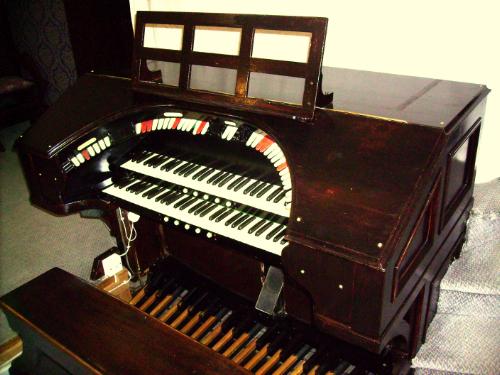
Things have certainly come a long way since Thursday 7th February 2008 the day I first saw and played the Wurlitzer organ which is installed in the Congregational Church, Beer, Devon. UK. That day proved to be a very
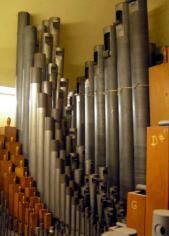 important date for me, and also for the Wurlitzer as, at that moment I vowed to set up a project which would ultimately restore the sad and dejected instrument before me to its former glory. Fortunately the members of the Church agreed so, with the help of Cynthia Dommett (Church Secretary) Friends of Beerwurly was immediately launched to raise sufficient money in order to commence the restoration.
After a lot of hard work by Glen and myself, not to mention much forebearance and tolerance by the Church, things are finally starting to take shape!
None of this would be possible without the help and support of our members, so my thanks go to all concerned.
Thanks for visiting this website.
Cheers!
Michael Cull.
www.organshow.co.uk
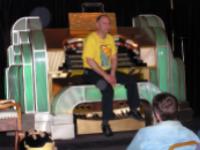
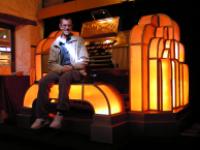 On Monday 23rd March 2009 our quest for knowledge of all things "organic" in the south west part of England and, more importantly our quest for spare parts, took us to Dingles Steam Museum near Launceston where we were warmly welcomed by Robin Roper of theTamar Organ Club which plans to fully restore and feature their ex-State Cinema (Dartford) Compton theatre organ there.
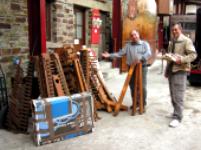 While we were there Robin showed us a collection of parts he had managed to salvage from a collection previously owned by the late George Metters, who had lived at Stoke Gabriel near Exeter and had earlier been closely involved with our own organ at Beer.
It seemed rather ironic to me when Robin then offered to donate a toy counter and glockenspiel from this assortment of parts, to our Beer project! Although a little "uncanny" it did occur to me that perhaps this might have been George's original intention for those parts. Who knows?
Whilst not being a particularly spiritual person, I have not failed to notice that things just seem to happen naturally as far as our restoration efforts are concerned. It is almost as though we are merely following a pre-planned course!
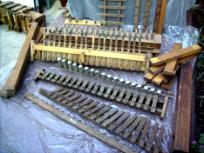
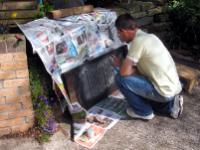 The photos here show, to the left, a pile of bits of a glockenspiel which is how we received them and: to the right, the now wire-brushed and de-rusted metal "notes" being sprayed with metallic silver paint while dangling on a row of nails hammered into the lower front panel of the house piano!
I never played the thing anyway as I prefer to take things easier these days, confining myself to my trusty Hammond A-100 tonewheel and Roland Atelier
- PLUS of course our Beer Wurlitzer!
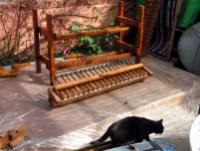
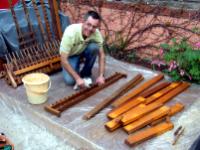 After Glen had finished cleaning and checking the wooden framework (left), he re-varnished it and was gradually putting everything back together, at which point my cat decided she had had enough of the whole thing and quietly slunk off to find a more tranquil setting in which to snooze!
Glen then proceeded to re-string the note supports before finally re-assembling the entire unit as shown here on the left, to a fully restored and functional
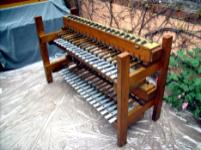 glockenspiel ready to be transported down to Beer.
Glen had spent a whole weekend "burning the midnight oil" cleaning, varnishing, assembling, modifying and wiring the whole unit single-handedly. As he had never before tackled such a task in his life, this was indeed a job "Well done"!
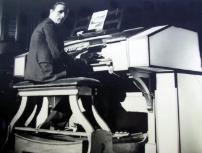 A welcome break from Glen's demanding physical regime came when, out of the blue, I received a telephone call from a then unknown Mrs Patricia Spencer.
Pat, as we soon came to know her, turned out to be the daughter of Wilfred Gregory an original resident organist at The Picture House Walsall the original home of our organ. The photo left shows him seated at our organ during its time there. The illuminated surround naturally did not find its way down to Beer as well!
I was astounded when Pat mentioned a scrapbook which had belonged to her grandfather and which contained many newspaper cuttings and photographs etc relating to our Wurlitzer's glory days of 1924. Pat said she also possessed some old 78rpm records of her father's playing, although these were recorded later on the Compton organ which was situated at the Tower Cinema in nearby West Bromwich.
I immediately contacted Glen as this information is more valuable to him as a
 researcher, archivist, historian and writer than it is to me.
Glen arranged to meet Pat and her husband Bob at their delightful secluded home high-up in the hills between Chard and Honiton.
Glen spent a pleasant few hours looking at Pat's scrapbook, taking notes and photographs of all the important events in her father's career before his untimely early death in a road accident: A tragic loss to the theatre organ world as, having listened to Wilfred's recordings, I can confirm he was a first class organist.
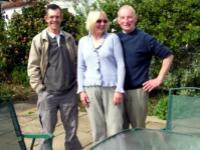
The photo to the right shows, left to right, Glen with Pat and husband Bob.
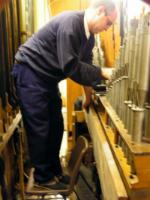 On Wednesday 15th April 2009 Andrew Fearn, the locally based organ builder mentioned above, spent a whole morning tuning the organ and was also able to sort out a few annoying faults which have developed recently.
Given that our "baby" is now 84 years old it is not surprising that bits fall off or become unstable, much in the same way as many of us find the same sort of thing happening to ourselves around that age - or even sooner!
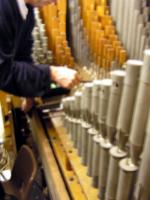
The photos to the left and right show Andrew up in the main organ chamber during the tuning process.
The actual tuning process would appear quite comical to most people as, because of all the background noise in the organ chamber, it is very difficult for the tuner to communicate with the key holder/note pusher who is seated at the organ console beneath pressing the necessary keys in sequence for the associated ranks of pipes to be tuned. Consequently to the casual observer a lot of (seemingly pointless) shouting takes place during the tuning process.
Shouts of "NEXT", "NEXT", "BACK", "STOP" etc are really the only signs of activity which are apparent to the likes of me who is just standing and watching.
It seems we may well need to invest in "walkie-talkies" before the next tuning session!
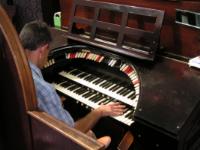 While the majority of musical instruments can be tuned chromatically, it is slightly different in the case of pipe organs.
For logistical reasons pipes are arranged at whole tone intervals next to each other on one side of centre, while semitones are arranged similarly on the opposite side of centre. This is what gives organ pipes their traditional symmetrical "mirror" curve. Please don't ask me why!
The photo to the left shows Glen patiently sitting at the console awaiting the next "shout" from above!
Having now seen Andrew in action I can heartily recommend him to anyone wanting technical expertise and assistance. He is located near Honiton (Devon) and can be contacted on 01404 811390, or by e-mail on enquiries@fearnorgans.co.uk.
 One of the items donated by Robin Roper, Dingles Steam Museum, which we collected in March was a toy counter. For the uninitiated this is simply a mechanical unit which is capable of bashing various non tuned percussion items, such as cymbals, bass drum, snare drum and the like.
The actual unit had been stored in rather unsuitable conditions before Robin acquired it, so it was almost unusable as none of the small leather motors which do the actual "bashing" were any good mainly owing to damp and mice!
 After thoroughly examining the unit I decided it would be worth restoring, if only because of its clever interior construction. It was clearly manufactured by the John Compton Company, but will be compatible with our Wurlitzer needs regardless.
Glen had already collected many Compton percussion instruments from Don Bray (Sussex) last year when he offered them to our project. I have also been able to acquire a bass drum plus some cymbals from an old drummer friend of mine who no longer needs them.
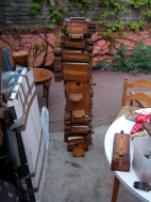
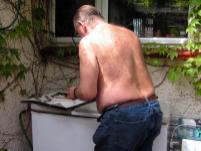
The photo to the right shows the toy counter, on its end, as we originally received it. The photo to the left shows me re-leathering one of the twelve motors which were removed from it, after all the motors were soaked in a bucket of hot water to dissolve the glue which was used to construct them in the first place. I apologise for this "topless" shot, but anyone who knows me will confirm this is my normal attire when working - even in winter - as the ladies at Beer Congregational Church already know!
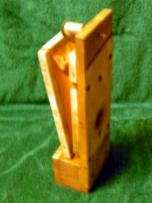 On a personal level, I feel there is a lot of "tosh" (pun intended) uttered by some organ restorers concerning the perceived art of re-leathering. Using a modicum of intelligent thought and careful planning I was able to design a cutting template then cut and fit a piece of suitable leather to a prototype motor at the first attempt!
The photo to the right shows my re-leathered prototype: the cymbal action of the Compton toy counter donated by Robin Roper at Dingles.
I was very lucky to enlist the support of Glover Bros Ltd, an upholstery wholesaler based at Broadgauge Business Park
Bishops Lydeard near Taunton who, although strictly a TRADE ONLY supplier, happily agreed to allow me occasional access to their leather "scrap box" as a goodwill gesture after I explained our difficulty in sourcing suitable leather locally.
My initial experimentation has led me to believe that upholstery leather will be an ideal solution. This option may well be of help to others working on organs and organ restoration also as, as far as I am concerned, all practical avenues should be well explored.
As I always say, "There are two choices: Either it works or it doesn't". Rest assured folks: If it doesn't work I will be the first person to say so!
My thanks go to the company directors and my contact John for their helpful advice, assistance and forebearance in allowing me to invade their warehouse from time to time. Well done!
More will follow on my progress as things happen. I think it might be a long job though as this is a very fiddly process, even for my nimble fingers!
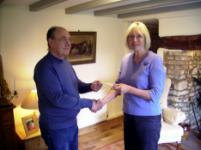 A welcome break from physical toil came on Saturday 25th April 2009, when Glen and I were invited to visit Pat Spencer and her husband Bob at their home (please see item featured above).
Some time ago Pat's mother sadly passed away, so Pat decided to hold the funeral service at Beer Congregational Church because of her late father's association with the Wurlitzer organ when it was originally installed in Walsall.
During the funeral service a collection was taken with the proceeds of over £200 being donated to our restoration project.
I was proud as acting Chairman FOB, to receive a cheque from Pat during our visit to her home.
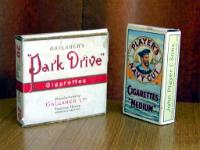 We were a little bemused when, on two separate occasions whilst ferreting for cables and the like under the floor boards adjacent to the organ console, we came across these two cigarette packets - empty of course - much to our annoyance being lifetime smokers!
How they got there is a matter of much speculation. Was it a preacher puffing in the pulpit? Was it an organist inhaling after the introit, or spliffin' in the sermon? Who knows?
It seems hard to believe that anyone would ever want to smoke in a church at all!
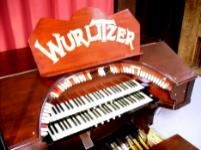 While I have been busying myself with re-leathering the toy counter motors, general administration, working on the wind supply to the secondary chamber (tardis) and generally making a nuisance of myself; Glen has been perfecting his carpentry skills in order to reproduce a genuine Wurlitzer music stand. A good job he made of it too, as these two photos show.
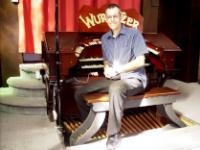 The one to the right shows the newly-mounted stand just after Glen fitted it, while the one to the left shows Glen proudly posing in front of it.
Unfortunately we will only be able to feature this new stand when staging our showcases, as it would look slightly out of place during the Church's regular services!
Who know's though?
On the "tuned" percussions front, we encountered a few unexpected (and surprising) wiring problems when we came to connect them to the organ!
Our setup still uses original electro-pneumatic relays (relay stack), which I have chosen to keep, although modern thinking enthusiasts seem to be easily led into replacing original mechanical relay systems with solid state versions. My own personal opinion is that solid state systems are rubbish!
After considering the views of others who have gone down that particular road and having also conducted a "straw poll" of members of one of the many theatre organ internet groups, I decided it would be more sensible to stick with what we already have. Until producers and installers of solid state systems get their act together and supply something guaranteed to work, we will keep our original relays.
Before the Wurlitzer was installed at Beer all the percussion relays were removed as it was believed, at the time, that the organ would be used only for worship purposes. That was well before we all decided to restore the instrument to its original specifications.
 When we first wired the cathedral chimes unit to the organ we found we couldn't turn the thing off! This unusual phenomenon was being caused by reversing polarities on the outputs from individual key contacts: keys in inactive mode were exhibiting -ve polarity which would then change to +ve polarity when the key was depressed.
Following some goodly advice from Alan Baker and Chris Clifton I decided to try incorporating diodes into our wiring circuits.
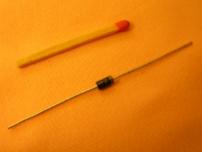
A diode (pictured above left with a matchstick for size comparrison) is essentially an "electric gate" which allows current to flow in one direction only.
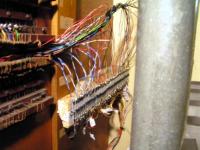
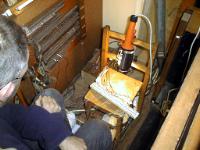 By constructing a dedicated percussions contact board, containing 49 such diodes which I mounted on a piece of wood (with each end looped around a carpet tack), we were able to overcome the original negative "loop" situation which made it impossible to turn our percussions off!
The photo to the left shows Glen busy with soldering iron, connecting all the contact wires up to the new board. The photo to the right shows the new board mounted in position, behind an existing set of six salicional pipes.
Chris Clifton also supplied me with a wiring diagram which will also allow us to fire individual non-tuned percussions, eg bass drum on pedals, from more than one note by using a similar arrangement of diodes.
We will report back on that in due course (hopefully) whenever I can get the toy-counter/trap tray restored!
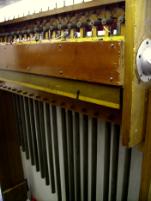 Nothing to do with Wurlitzer organs is ever easy!
Just when we thought our problems were over, we found that when we finally connected up the chimes, chrysoglott and glockenspiel they all wanted to work together at the same time - whether we wanted them to or not!
Another 150 diodes plus half a ton of solder eventually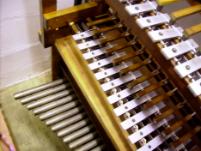 stopped them "talking" to each other.
The photo to the left shows the cathedral chimes, now fully wired and winded.
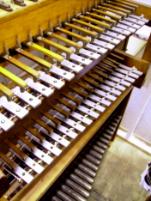
The photo to the right shows the left end of the glockenspiel unit mounted on top of the chrysoglott. The chrysoglott resonators sticking out, just above floor level, are all that can be seen in this photo as space limitations inside the chamber make it very difficult to take snapshots!
 The new percussions were given their first public "debut" when Richard Monks presented our June Organshow.
I, as Acting Chairman, naturally had the privilege of being (technically) the first person to actually play the percussions in public as I couldn't resist the temptation to incorporate the cathedral chimes into my opening introductions!
Richard then ably demonstrated the rest during his performance.
 The photo to the left shows the right side of the glockenspiel as mounted on top of the chrysoglott.
We now just need to maneouvre the xylophone unit into position on the top of these two, which should indeed be a barrel of laughs!
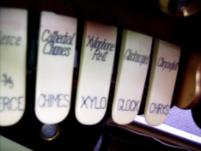
The photo, here to the right, shows the new percussions stoptabs in their correct position on the console.
Short mp3 sound clips can be downloaded by right-clicking and then selecting "Save target as........" HERE for my Chimes, HERE for Richard's Chimes and HERE for Richard's Glockenspiel.
One major problem we have encountered during the percussions connecting-up process, is finding suitable pipework which is compatible with Wurlitzer wind trunking.
Most of the add-ons originally fitted to our organ utilised a 2" diameter wind supply. This size of pipework is now almost impossible to obtain, as everything is now metricated to comply with industry standards.
I have been experimenting with a batch of 2" drain pipe which I found available at Old Harry's Reclamation in Taunton - Harry Riste, a former demolition contractor, having been an acquaintance of mine for more years than I care to remember!
 Using this pipe, which is very economical to purchase, tends to be a bit tricky and fiddly as there are no compatible fittings available. It is therefore necessary to use a mitre saw and self-adhesive bitumen "flashing" when wanting to change direction!
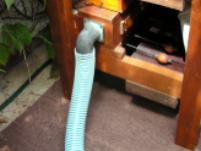
I have also been trying out a type of plastic flexible hose which does the job perfectly, although it does tend to be a bit on the expensive side.
The photo to the left shows a length of this hose fitted to part of our xylophone unit.
My local supplier is Hydramatic (Somerset) although the firm does have outlets in other parts of the Country for anyone else who might want to try this idea.
 We are now starting to turn our attentions towards the shutters as I have found a set of pneumatic actions in USA which are of the same specification as our existing set which, although of genuine Wurlitzer origin, were fitted with a mechanical "tracker" action when the organ was installed at Beer.
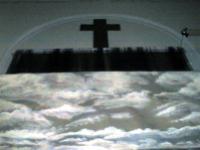
The illustration to the right shows the shutters aperture from the church side, as well as the paper mural which partly obscures it.
Additionally the ten shutter blades had also been obscured with lengths of muslin which had been dyed/painted gold to match the gold coloured cross above.
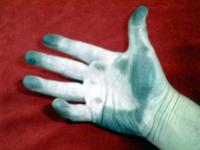 To my horror I found that the chamber side of this material was also covered with a generous layer of black SOOT.
Nearly fifty years have elapsed since the Wurlitzer left the Black Country, so we were somewhat taken aback when we discovered that the soot is still inside! The photo to the left shows the state of my right hand after I had rubbed it across the inside part of the muslin.
As an aside: I am naturally right-handed, so found some difficulty in photographing my right hand with the camera held in my left hand!
The muslin was quickly removed with a "Stanley" knife. We were then delighted to hear how much better the organ sounded as a result!
 On Saturday 27th June 2009 Glen and I spent several hours as guests of a rather charming lady living near Sedgley (West Midlands), whom I had been able to trace during my research into the history of our Wurlitzer.
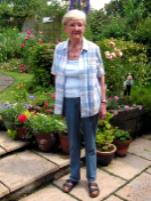
Mrs Muriel Hickling, pictured right, is the surviving wife of Allan Hickling who had supplied the organ to Beer Congregational Church back in 1958. Sadly Allan passed away in 1996 but I was able to contact his son Anthony who, after a chat with his Mother, was able to put us in contact with her.
Mrs Hickling at the remarkable age of 91 still drives and also smokes, although she did say that she never inhales! She is very proud of the longevity of her parents, so I know she will not mind me revealing her age.
The main reason for our visit was to have a look at Allan's scrapbook which contains details and historical data relating not only to all the pipe organs which he installed at Dormston House while living there, but also personal signed "guestbook" entries made by the many professional organists of the day who performed and practiced on them.
There is also an update on the Organ Details page concerning Allan Hickling.
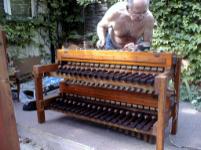
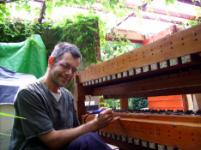 Meanwhile work on the xylophone was being completed off-site, as a lot of the work is.
Glen had already been busy with cleaning, varnishing and re-assembling all the parts; so when everything was back where it should be I used up another 37 diodes - one for each magnet - and then did a quick continuity check on each diode and magnet to make sure each circuit was correct (photo to left) before Glen set about soldering the new wiring loom connections to each of them (photo to right).
 On Tuesday 30th June 2009 we were finally ready to take our xylophone unit down to Beer and install it in the new percussion chamber.
All the restoration and preparation work had already been carried out by both of us at home, so all that was left was to place it in position.
I had quickly constructed a "wind box" to fix onto the ends of the two units, so all we really needed to do was to heave the unit into place on top of the chrysoglott and glockenspiel units.
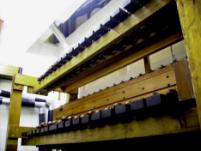 That was easier said than done, the xylophone unit being much heavier than anticipated!
With some inventive use of a couple of chairs and a table Glen and I were able to slide the unit upwards into position through the side wall of the chamber, after removing some of the MDF panels which form the chamber enclosure.
The photo to the left (above) shows the "tower" formed by the three units and was taken while Glen was making the final electrical connections. The photo to the right shows a close-up of the xylophone in position.
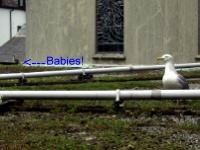 Whilst at work in and around the percussion chamber, and also while popping outside to the side alleyway for our regular "smoke-breaks" - I have now given up trying to do this in the toilets following howls of protest - we couldn't fail to notice that we now appeared to be causing some annoyance to the resident seagulls which seemed to be making more noise than is usual!
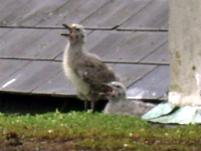 The presence of a dead crow in the alleyway, as well as the sounds of youthful chirping, aroused my curiosity (and suspicions) to the extent that I then
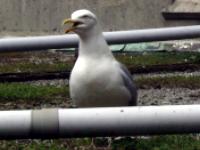 decided to investigate.
Lo and behold there were a couple of seagull fledglings hooting and hollering, presumably for food, on top of the flat roof which covers the church hall.
The intrepid Glen took the photos which appear each side of this article as I didn't feel too comfortable with the menacing look on dad's face, particularly as he seemed to be trying to tell us to "clear off".
Glen, on the other hand, says he has always got on well with birds!
Rather him than me!
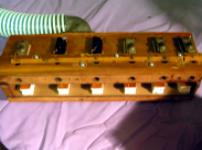 Glen and I have both been having problems with one of the original parts of the organ, a small Salicional chest which originally contained twelve 8' pipes. These pipes work on the lowest twelve notes of the manuals, and also on the pedals.
When the Wurlitzer was re-located to Beer in 1958 space considerations necessitated this chest being split into two separate units which were then installed one on each side of the shutters, with the longer metal pipes being mitred at 45 degrees because of the arched ceiling.
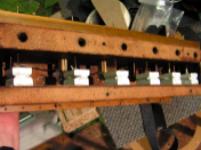 Glen had earlier dismantled the one unit of these two which was giving us problems at the beginning of the year, but found that there was no quick or easy fix because many of the rubber stabilisers under the valves on the valve stems had worn out and simply wouldn't stay in place. The thin zephyr material originally used to "leather" the primary motors was also in a most parlous state and two of the six magnets were dead, so had to be replaced!
To prevent performance problems the unit was removed completely until we had enough time to rebuild it. This was a project which I eventually inherited!
As we presently don't possess any leather thin enough for this type of work, I posted the six primary motors to Paul Corin in Liskeard.
Paul was kind enough to re-leather them in double-quick time at a most reasonable cost, which meant we had them back within a week.
The two photos above, left and right, show the newly re-leathered primary motors and also the two new magnets.
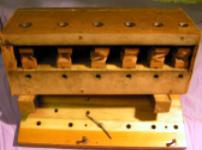
 Small rubber tap washers - cut into three narrower slices - were then glued to the valve pads to replace the stabilisers which were worn. As the valve stems are threaded, it is essential that the pads do not slide up and down on the threads.
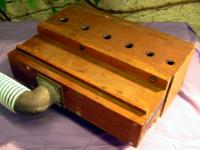
The photo to the left shows the secondary motors, which allow pressurised air from inside the chest to enter the pipes via the holes on the top. The photo to the right shows the re-assembled unit which we hope will now be in 100% working order.
I am using another length of flexible hose at the moment, as this makes it easier to adjust the valves before connecting back to a fixed air supply.
Sorry if this item appears to be a bit more wordy than is usual, but I had to re-write part of it for the benefit of a self-styled "expert" who didn't seem to know what was going on! Clearer now, Mr D?
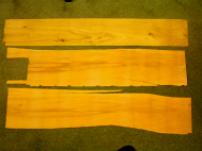 In between all our other activities, Glen has been gradually refurbishing parts of the console. In addition to brush-painted brown his labours were further complicated by my own efforts on the bench last October, when I gave most of it a couple of coats of matt black emulsion before our inaugural concert!
During his preparation for re-staining and varnishing the bench Glen discovered that some of the wood veneer had been lost or damaged over the years, which is probably why I resorted to the matt black!
Some detective work led me to Mundy Veneer Ltd, just a couple of miles away from where I live. The firm is strictly a wholesale supplier but I, being the cheeky devil I am, decided to pop my head in their door to see if they knew of a local retailer who could sell me a small piece.
When I explained the reason, the nice gentleman I spoke to readily agreed to let me plunder their box of offcuts and take whatever I needed (pictured above left).
Thanks guys.
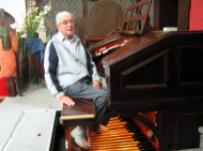 Another pleasant departure from our toils came when I was telephoned by Art Young from Ashford (Kent), a former resident organist at the Forum Cinema (Ealing) where he played the three manual nine rank Compton organ which is now installed at Wormwood Scrubs Prison chapel.
Art was going to be visiting our area during the middle of August 2009 as part of a holiday break, so naturally wanted to try our Wurlitzer.
We were delighted to welcome him on Friday 21st August when he spent a couple of hours putting the organ through its paces.
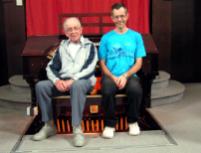 His visit was even more enjoyable when he learnt that my colleague Glen is also involved with the restoration project and would be present, as they already knew each other through their mutual involvement with the Rye Wurlitzer on which Art has performed many times since Friends of Rye Wurlitzer was formed in 1993. The photo to the right shows Art and Glen seated in front of the Wurlitzer.
After Art left the Forum Cinema he went on tour for a cinema circuit in Canada, before returning to England and finding work as a demonstrator of Hammond organs, as many former cinema organists did.
Even at the grand old age of 87, Art still possesses that "touch of professional class"!
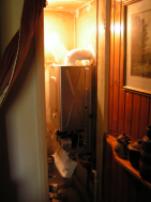 An unpleasant diversion from matters organic came when my hot water tank at home decided to spring a leak, the week before our "Wurlitzer Week"!
I had planned to replace my antediluvian back boiler next year in any case, as my service engineer keeps nagging me every time he does the annual service as parts are getting very difficult to obtain. I had definitely not bargained on having to start the job during "Wurlitzer Week" though!
It therefore became necessary for me to take a couple of days off from Beer, leaving Glen to run the show on his own, so that I could remove the offending hot water tank before all the carpets etc were ruined. This did nothing to improve the somewhat volatile mood swings I have suffered since a major mental breakdown took me out of action for 2.5 years ten years ago. These have made me rather notorious in some circles over the past couple of years!
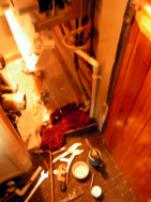
Today, 10th September 2009, sees the latest project near completion, which will please all my acquaintances who have had to suffer over the past few weeks on account of my non-possession of running hot water! I apologise unreservedly for this!
One thing I have learned from the exercise though is that while Wurlitzer restoration can be a very pleasurable process, the mechanics of central heating "pipe work" is a darned sight easier than that which is involved with Wurlitzers! Apart from that there ain't much difference really.
The photo above (left) shows the newly mounted boiler after I had worn myself out knocking a ruddy great 5" hole through the cavity wall to take the flue.
The photo to the right shows some of the intricate "pipe work" necessary to link the new boiler with the existing plumbing.
That reminds me: I think I should check to see if my buildings insurance covers me for explosions!
Available to everyone is Glen's book, "The History of the Beer Wurlitzer" priced at £3.50. All proceeds from the book go to the Restoration Fund. Please Contact us for more information.
More Wurlitzer produce will become available over the coming months but, for now please bear in mind that the oldest Wurlitzer theatre organ in the country still needs your help.


oldest wurlitzer,beer,devon,uk,oldest,theatre,theater,cinema,organ,organs,restoration, concerts,first,congregational,church,beerwurly,glen,twamley,books,history,walsall,compton,christie,cinemas